Altalena wreck found intact off Israel's coast at 503 meters
By the BreakFirst Newsroom
Source: Survey of Israel Marine Mapping Division
The wreck of the Altalena, the arms ship whose sinking in June 1948 became one of the most bitterly contested episodes in Israel's founding, has been located intact on the Mediterranean seabed, Israeli officials announced Monday. The Times of Israel reported that National Security Minister Itamar Ben Gvir and Heritage Minister Amichai Eliyahu said in a joint statement that the vessel was found at 12:30 a.m. at a depth of 503 meters, roughly 20 kilometers off Israel's coast, "during a complex maritime search operation." According to Israel National News, the expedition was launched at the initiative of Eliyahu and managed by Roni Sadeh, director of the Marine Mapping Division at the Survey of Israel.
Ynet reported that the wreck was located using sonar systems, which map the seabed with sound waves, and noted that divers cannot operate at depths beyond 500 meters, making remote sensing essential to the search. Sadeh told the outlet that the team reached the ship thanks to advanced technology and intensive work at sea. Hagai Ronen, director general of the Survey of Israel, said the find showed how mapping technology can document significant historical sites, and that the agency would work to record and preserve the wreck, according to Ynet. Israel Hayom reported that the Survey of Israel said the technology allowed the team to document the wreck's precise coordinates.
JNS reported that Israel's Heritage Ministry invested one million shekels in the search and hired the Israel Oceanographic and Limnological Research institute, through the Survey of Israel, deploying the national research vessel Bat Galim. Al-Monitor reported that the ministry's funding dated to August 2025 and that Likud figures including Justice Minister Yariv Levin and Prime Minister Benjamin Netanyahu had for years advocated using public funds to find the wreck. A military spokesperson told The Times of Israel that the IDF had no involvement in the operation.
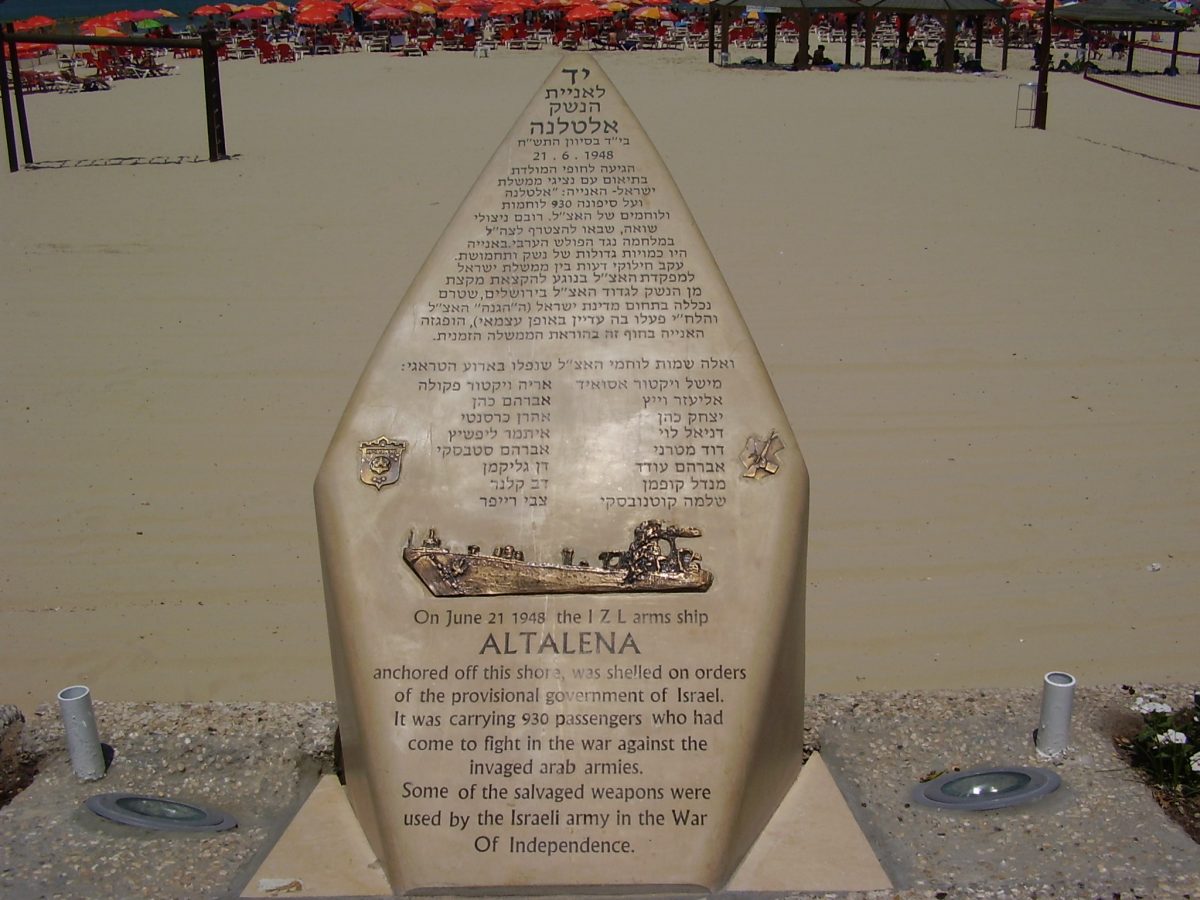
The ship at the center of the search sailed from France in June 1948 carrying roughly 930 immigrants, including Holocaust survivors and Irgun fighters, along with a large quantity of weapons, Ynet reported. The Jerusalem Post noted that its arrival came weeks after Israel's May 14 declaration of independence, as separate Jewish armed groups were being folded into the newly created IDF under an agreement signed on June 1, though Irgun forces in Jerusalem remained independent. According to the Post, Irgun commander Menachem Begin sought to allocate 20 percent of the arms to his forces in Jerusalem, while Ben-Gurion insisted the entire cargo be handed to the army.
JNS reported that when the Irgun resisted, clashes erupted at Kfar Vitkin and later off Tel Aviv, where IDF troops under Yitzhak Rabin shelled the vessel, and that Begin ordered his men not to return fire in order to avert a civil war. Sixteen Irgun members and three IDF soldiers were killed, JNS and Israel Hayom reported. The Times of Israel reported that Begin later said his greatest accomplishment was not retaliating. JNS reported that the ship ran aground at the foot of Frischman Street and, about a year later, was refloated, towed some 15 miles out to sea and scuttled.
Israel Hayom reported that Ben-Gurion long presented the episode as a demonstration of the rule of law and the state's monopoly on force, while the Israeli right has cast it as unnecessary bloodshed that deprived fighters of badly needed arms. Al-Monitor reported that the affair has remained a subject of deep political controversy, and that Yigal Amir, the assassin of Yitzhak Rabin, invoked it to justify his actions.
The discovery immediately became a political flashpoint. Ynet reported that Netanyahu vowed to raise the wreck and that the announcement set off a battle over credit, with the prime minister delivering a separate statement outside the Etzel Museum rather than appear alongside Ben Gvir. The Jerusalem Post, citing Maariv, reported the two had been expected to speak jointly before deciding at the last minute to separate. The Times of Israel reported that Netanyahu said he would order the ship raised and turned into a monument, calling it a "defining moment," while Ben Gvir said the find closes a "bleeding wound" for the Israeli right and appeared to liken himself to Begin.
What happens to the wreck remains unresolved. The Times of Israel reported that experts have said raising the ship will be difficult, costly and possibly impossible, and Ynet reported that no decision has been made, with options under consideration including a floating memorial, a maritime heritage center, or recovering selected parts.