BreakFirst
Live
Social Media Aug 25, 2026 2:23 AM (1 hour ago)

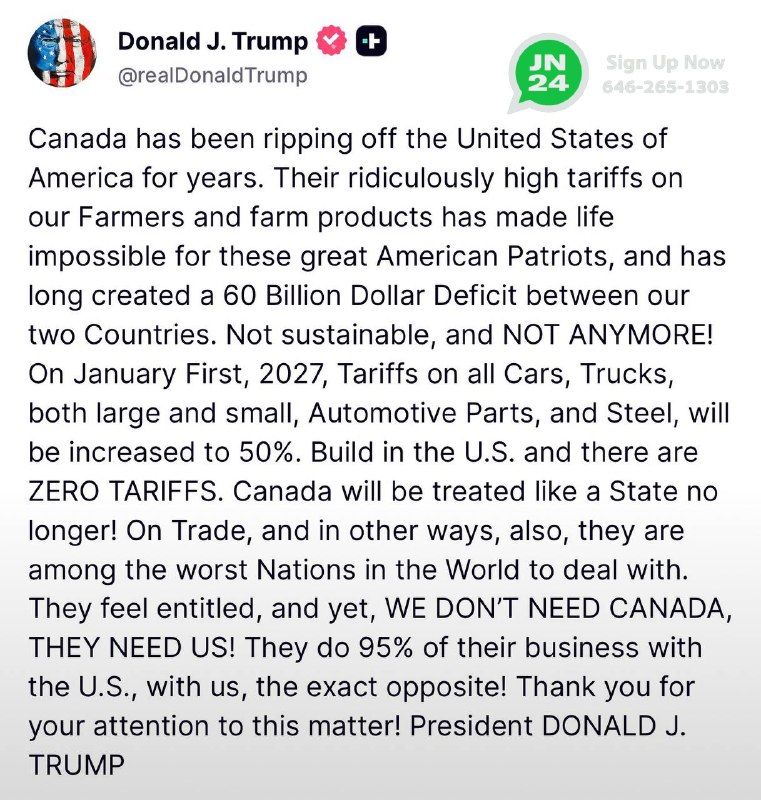
BREAKING: Trump says Canada tariffs rise to 50% in 2027

Source: Donald Trump

Advertisement

Good, plenty of coverage. Let me get more details, especially on the "state" comment, Carney's response, and background on the trade war.Now I have enough material. Let me draft the article.Now I have solid background. Time to write the article.President Donald Trump announced Monday that the United States will raise tariffs on Canadian-made vehicles, auto parts and steel to 50 percent starting Jan. 1, 2027, an escalation that CNBC reported the president unveiled in a Truth Social post declaring the current arrangement "Not sustainable, and NOT ANYMORE!"

According to CNBC, Trump wrote, "On January First, 2027, Tariffs on all Cars, Trucks, both large and small, Automotive Parts, and Steel, will be increased to 50%." The Washington Examiner reported that Trump framed the move as a response to Canada "ripping off the United States of America for years," citing what he called high Canadian tariffs on American farm products. Fox Business reported Trump has pointed to a trade deficit with Canada as justification for the escalation, with the Washington Times noting he put the figure at "the $60 billion budget deficit that exists between the two neighbors."

Advertisement

The post also contained pointed language about the broader relationship. Al Jazeera reported that Trump wrote, "Canada will be treated like a State no longer!" and that he described Canada as "among the worst Nations in the World to deal with" on trade and other matters. The Washington Times reported that Trump added, "They feel entitled, and yet, we don't need Canada, they need us," and claimed Canada does the vast majority of its business with the United States. Yahoo News reported that Trump said vehicles built in the United States would not be subject to the new tariffs, consistent with his repeated message that companies should relocate production domestically to avoid the levies.

The announcement is the latest turn in a trade war that has been escalating for months. According to CBS News, Trump has already relied on Section 338 of the Tariff Act of 1930 to impose 50 percent tariffs on hundreds of Canadian goods, a legal authority that trade attorneys and law firms tracking the dispute say had never previously been invoked by a U.S. president for this purpose. Those earlier proclamations, signed July 20, covered roughly $20 billion worth of Canadian imports, or about 5 percent of total U.S. imports from Canada, according to legal analysis from White & Case. A CNBC report from mid-August noted Trump had briefly paused a scheduled round of those tariffs and floated a "deal" with Ottawa, but talks subsequently broke down.

Fox Business reported that marathon trade negotiations between Washington and Ottawa collapsed shortly before a deadline last weekend, prompting Canadian Prime Minister Mark Carney to say his country had been "attacked" and to vow retaliation. Alaska Public Media reported that Carney said Friday night, "Canada will match those tariffs dollar for dollar to protect our workers and businesses," with retaliatory measures targeting American steel, dairy, appliances, agricultural equipment, pulp and paper, and electronics industries. Al Jazeera reported those Canadian countermeasures are set to take effect Sept. 8. CNBC reported that U.S. Trade Representative Jamieson Greer said the administration pushed back on Canadian negotiators after already "cutting tariffs in half on steel, on aluminum, and extensively reducing them on autos," arguing Canada "simply ... wanted more."

Trump's Monday post did not specify whether the 2027 increase would be implemented through a new executive proclamation, an expansion of the existing Section 338 authority, or another legal mechanism, and it offered no detail on potential exemptions beyond the reference to U.S.-built vehicles. There was no immediate public response from Carney's office to the specific 2027 announcement, according to available reporting at the time of publication.

The dispute carries significant stakes for North America's integrated automotive supply chain, which has for decades relied on parts and vehicles crossing the U.S.-Canada border multiple times during production under the North American trade framework. Analysts cited in CNBC's coverage noted the Canadian dollar slid as the two governments moved toward what one report described as an "all-out trade war." With Canadian retaliatory tariffs slated to begin in September and the new U.S. auto and steel rate not set to take hold until January 2027, both governments have more than a year in which further negotiations, or additional escalation, could still reshape the terms of the dispute.

Advertisement

More from the wire