Netanyahu: UNRWA Compound in Kafr Aqab Being Evacuated
By the BreakFirst Newsroom
Source: Benjamin Netanyahu
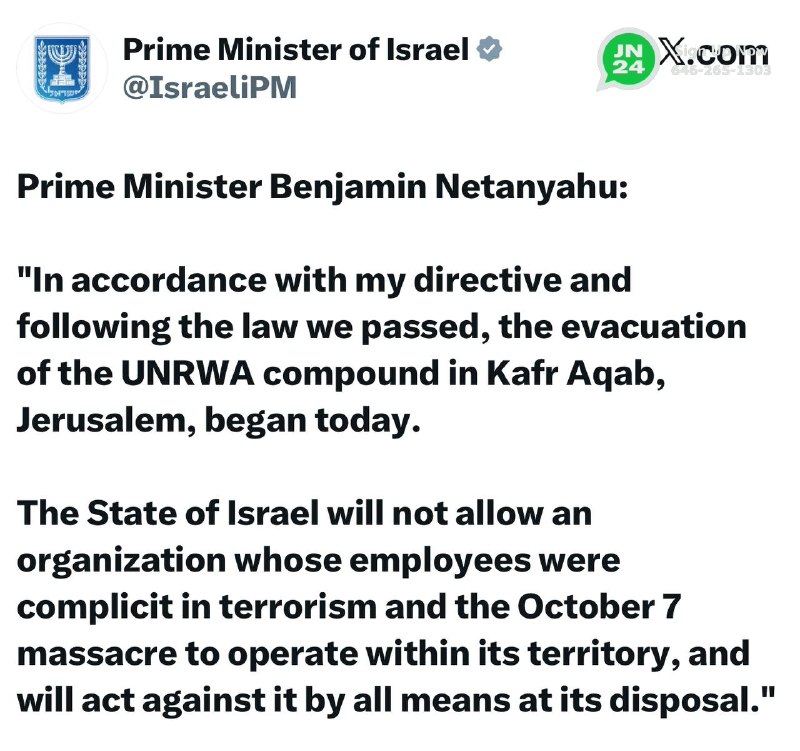
Prime Minister Benjamin Netanyahu announced Thursday that Israeli authorities have begun evacuating a compound run by the United Nations Relief and Works Agency, known as UNRWA, in the Kafr Aqab neighborhood of Jerusalem, according to a statement from his office. The move marks one of the most direct actions yet taken by Jerusalem against the embattled UN body's physical footprint in the city, and it comes amid mounting Israeli legislative and political pressure to curtail UNRWA's operations altogether.
According to Netanyahu's statement, the evacuation is being carried out "in accordance with... the law we passed," a reference to Israeli legislation passed in recent months that restricts UNRWA's activities within Israeli-controlled territory, including in Jerusalem. The prime minister's office framed the action as a straightforward matter of law enforcement and national sovereignty rather than a diplomatic gesture, signaling that Israel intends to treat the UNRWA presence in the capital as a legal and security matter rather than a humanitarian one. No details were immediately released on where occupants of the compound would be relocated or on a timeline for the site's full closure, and BreakFirst will update this story as Israeli officials release further information.
The Kafr Aqab move fits into a broader pattern of Israeli pushback against UNRWA that has intensified since the October 7 Hamas massacre, after which Israeli officials and independent investigators alleged that UNRWA employees had participated in or had knowledge of the attack and that the agency's schools and facilities had been infiltrated by Hamas operatives. Those allegations, which UNRWA has disputed, prompted the Knesset to pass legislation banning UNRWA from operating on Israeli sovereign soil and barring Israeli authorities from any contact with the agency. Critics of UNRWA, including many in the Israeli government, argue the agency has long functioned as a vehicle for Palestinian irredentism rather than neutral humanitarian relief, a criticism conservative commentators in the U.S. and Israel have voiced for years even before the current war.
Supporters of the crackdown say the Kafr Aqab compound's closure is a natural extension of a policy Israel has pursued since the war began, one aimed at ensuring that no organization credibly linked to Hamas sympathizers retains an operational base inside the capital. That effort has run parallel to the Israel Defense Forces' broader campaign to dismantle Hamas's command structure, including the killing of senior Hamas figures such as the Hamas commander who held Israeli hostages and other October 7 perpetrators. The government has repeatedly argued that dismantling networks tied to the October 7 attack — an atrocity survivors like freed hostage Evyatar David have described in harrowing detail — requires action against any institution, foreign or domestic, suspected of providing cover for the terror group.
UNRWA has for years denied Israeli accusations of complicity with Hamas, insisting it operates as a neutral humanitarian body serving Palestinian refugees across Gaza, the West Bank, Jerusalem, and neighboring Arab states. The agency has warned that curtailing its activity in Jerusalem would strip essential services from thousands of Palestinian residents who rely on its schools, clinics, and aid distribution. Netanyahu's government has largely dismissed those warnings, arguing that Israel's sovereignty and security concerns take precedence and that alternative arrangements can be made for humanitarian needs without UNRWA's involvement.
What happens next remains unclear. Netanyahu's office did not specify whether the Kafr Aqab evacuation is the first in a series of planned closures targeting other UNRWA facilities in Jerusalem, or whether it represents an isolated enforcement action tied specifically to the site in question. Israeli officials have signaled in the past that they intend to enforce the UNRWA law broadly, and observers expect further compound closures or restrictions to follow as the government presses its case that the agency's continued presence poses a security risk to the capital.